

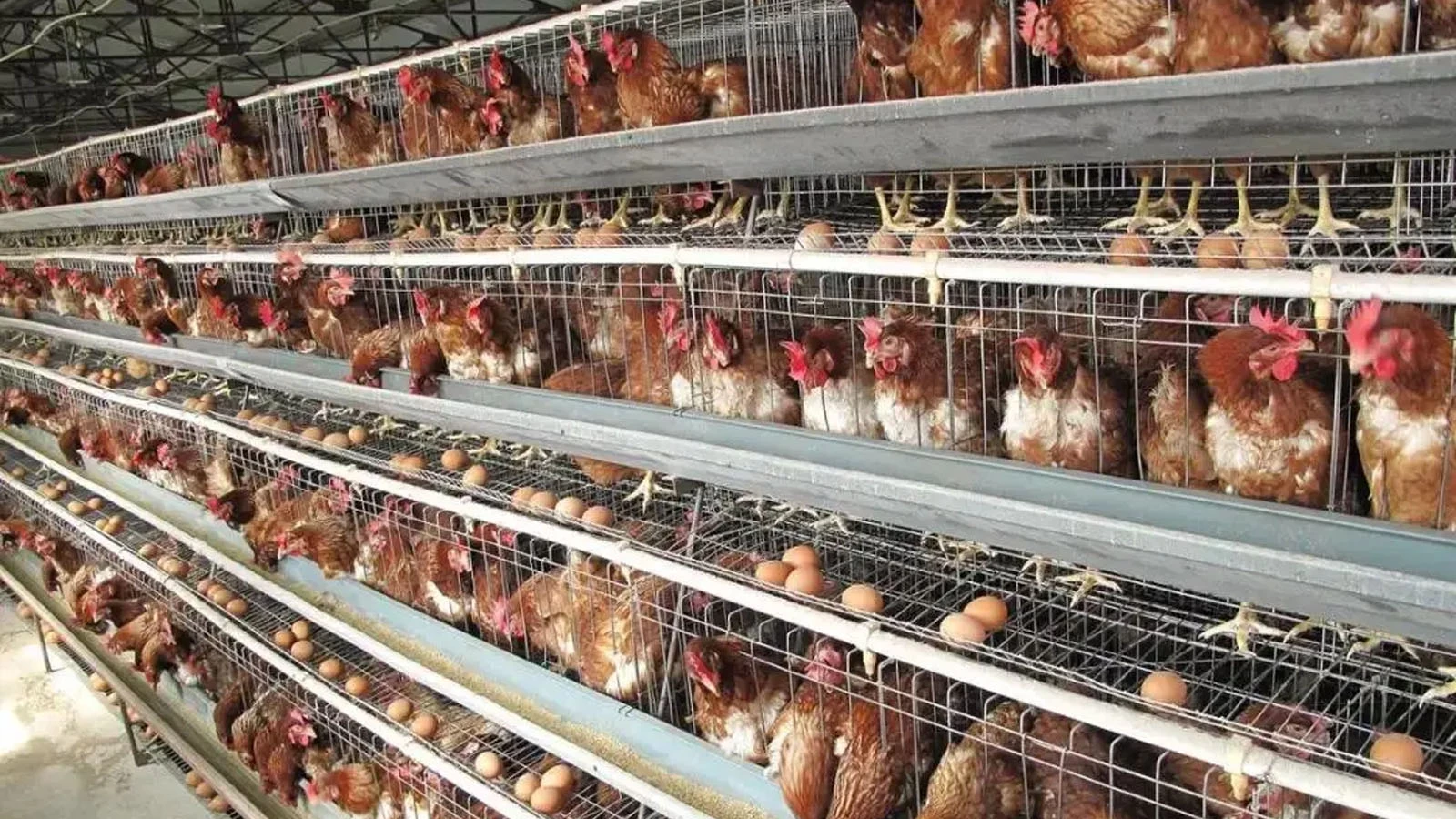
Walk into a modern multi-tier caged layer house, check the controller, and everything might look perfect: a steady 22℃(71.6℉). Yet, your flock is coughing, feed intake is erratic, or egg production is dropping.
What went wrong?
The answer lies in a common trap: confusing dry-bulb controller readings with the actual "effective temperature" (wind-chill and thermal comfort) felt by birds inside the cages.
Unlike floor-reared broilers or layers that can move around to find comfortable microclimates, caged birds are locked at specific tier heights and density zones. Managing ventilation in caged layer systems requires shifting from "feeling-based" adjustments to quantified environmental control.
1. Dry-Bulb Temperature vs. Effective Temperature
Chickens do not feel dry-bulb temperature alone; they respond to heat loss driven by ambient temperature, relative humidity (RH), and air velocity across their feathers.
Effective Temperature = Dry-Bulb Temp - (Airspeed x Chill Factor) + (RH Correction)In caged systems, three major variables distort the temperature reading on your central controller:
A. The Dual Role of Relative Humidity
In Hot Conditions ( > 28 ℃/82.4 ℉): High humidity severely restricts a bird’s ability to dissipate heat through panting. Every 10% increase in RH above 60% raises the effective temperature by approximately 1.0° C to 1.5° C.
In Cold Conditions (< 18° C/64.4 ℉): Damp air accelerates body heat loss. A 10% jump in RH makes cold air feel 0.5° C to 1.0° C colder, often triggering chill stress and respiratory outbreaks during winter minimum ventilation.
B. Vertical Thermal Stacking (Tier Temperature Variance)
Hot air naturally rises. In a 4-tier or 8-tier caged house, temperature differences between top and bottom tiers can reach 2.0°C to 3.5°C..
If your sensor is placed at mid-height reading 22° C:
Top Tier: Birds may experience 24° C with stagnant air (stuffy/heat stress).
Bottom Tier: Birds may experience 19.5°C under drafts (cold stress).
C. Drafts from Low Static Pressure
When sidewall inlets lack adequate negative pressure during minimum ventilation, cold incoming air drops directly onto the top tier instead of mixing at the ceiling peak. An air speed of just 0.5 m/s (100 fpm) at 15° C drops the effective temperature by up to 3°C instantly.
2. Quantified Management Checklist for Caged Houses
To eliminate microclimate dead zones and protect flock performance, implement these measurable targets:
| Parameter | Target Standard | Actionable Solution |
Top-to-Bottom Tier Temp Delta | <1.5°C(2.7°F) | Run destratification / vertical circulation fans to blend air layers. |
Inlet Throw Velocity | 3.5 to 4.5m/s(700 - 900 fpm) | Match inlet opening size to fan capacity to maintain proper static pressure. |
Airspeed at Cage Level (Minimum Vent) | ≤0.2 m/s (40 fpm) | Install air deflectors on sidewall inlets and near sidewall fans. |
Target Relative Humidity | 50% to 60% | Fog/humidify if < 40%; increase heat and ventilation if > 70%. |
Summary
In caged layer production, uniform performance requires uniform air distribution. Don't let a single wall sensor mislead you—quantify airspeed, humidity, and tier temperature differentials to ensure every bird in the house experiences true thermal comfort.