

Modern commercial cattle farming requires a systematic approach combining proper breed selection, balanced nutrition, strict biosecurity, and optimal barn environments. Whether you are starting a new beef feedlot or expanding a dairy farm, this guide covers the foundational pillars of successful cattle production.
1. Breed Selection & Introduction Management
Selecting the right cattle breed determines your farm’s growth rate and product quality:
Simmental: Outstanding growth rate ($1.2 - 1.5\text{ kg/day}$) and roughage tolerance, ideal for northern regions.
Charolais: High lean meat yield and strong cold resistance, gaining $1.3 - 1.6\text{ kg/day}$.
Angus: Renowned for superior meat marbling and early maturity, well-suited for southern hilly pastures.
Holstein & Jersey: Top choices for dairy production, with Jerseys offering high milk fat rates ($4.5\% - 5.5\%$).
Quarantine Notice: Always enforce a 21-day isolation period for new animals and verify official veterinary health certificates before introducing them to the main herd.
2. Precision Nutrition & Feeding Strategy
Feeding strategies must adapt to the animal's growth stage:
Beef Cattle Fattening: A balanced concentrate ratio of 60% corn, 20% soybean meal, 15% wheat bran, and 5% premix paired with silage corn and straw ($15 - 20\text{ kg/day}$).
TMR Technology: Total Mixed Ration (TMR) mixers blend forage and concentrates uniformly, eliminating selective feeding and improving feed conversion efficiency by up to 10%.
3. Housing Design & Automated Equipment
Comfortable housing directly influences daily weight gain and milk yield:
Space Requirements: Allocate $8 - 10\text{ m}^2$ per fattening bull and $12 - 15\text{ m}^2$ per lactating cow.
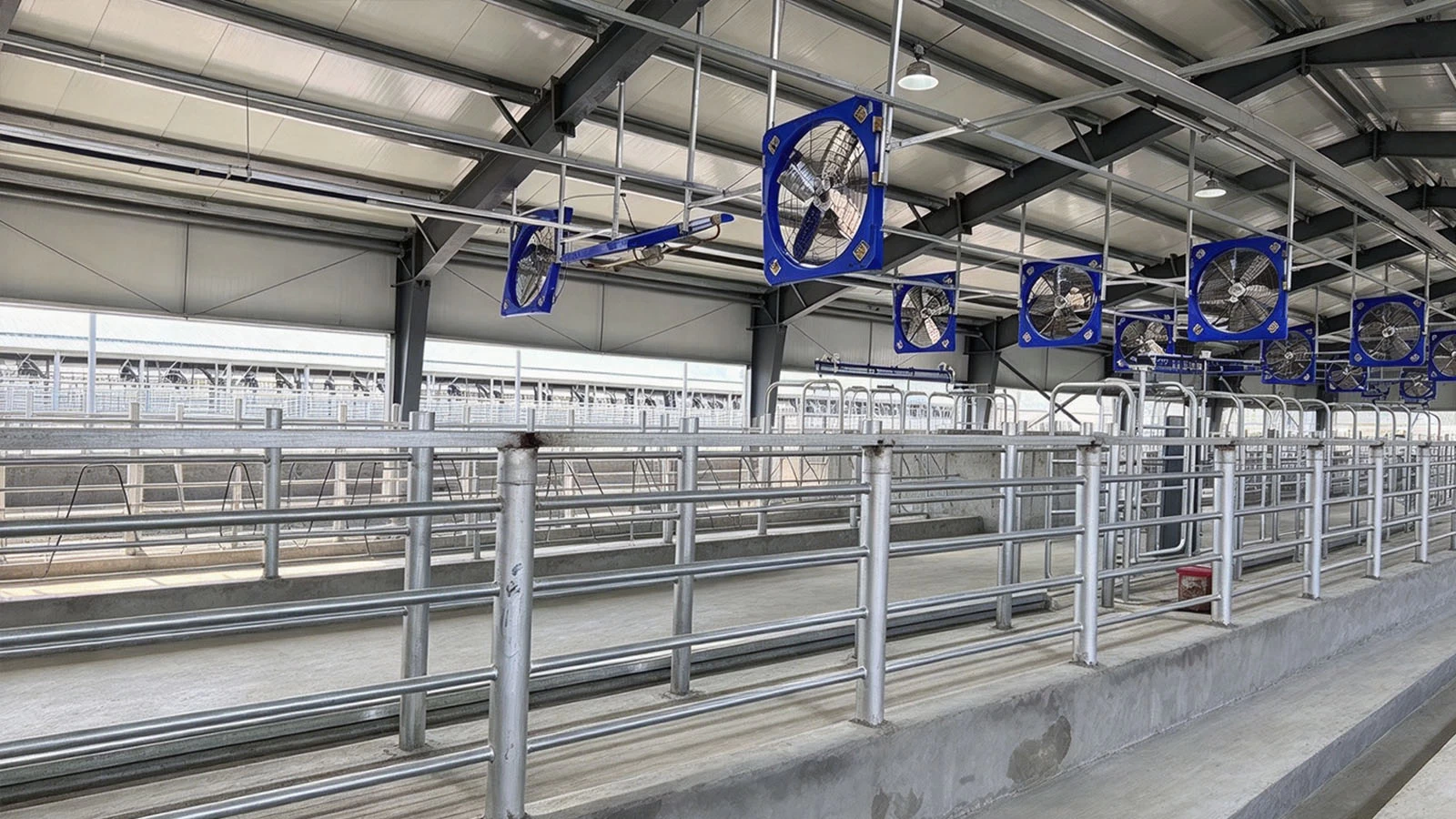
Environmental Equipment: Install mechanical negative pressure fans ($1.1\text{ kW}$ fan per $100\text{ m}^2$) combined with evaporative cooling pads to keep ambient temperatures below $28^\circ\text{C}$ and humidity under $70\%$.