

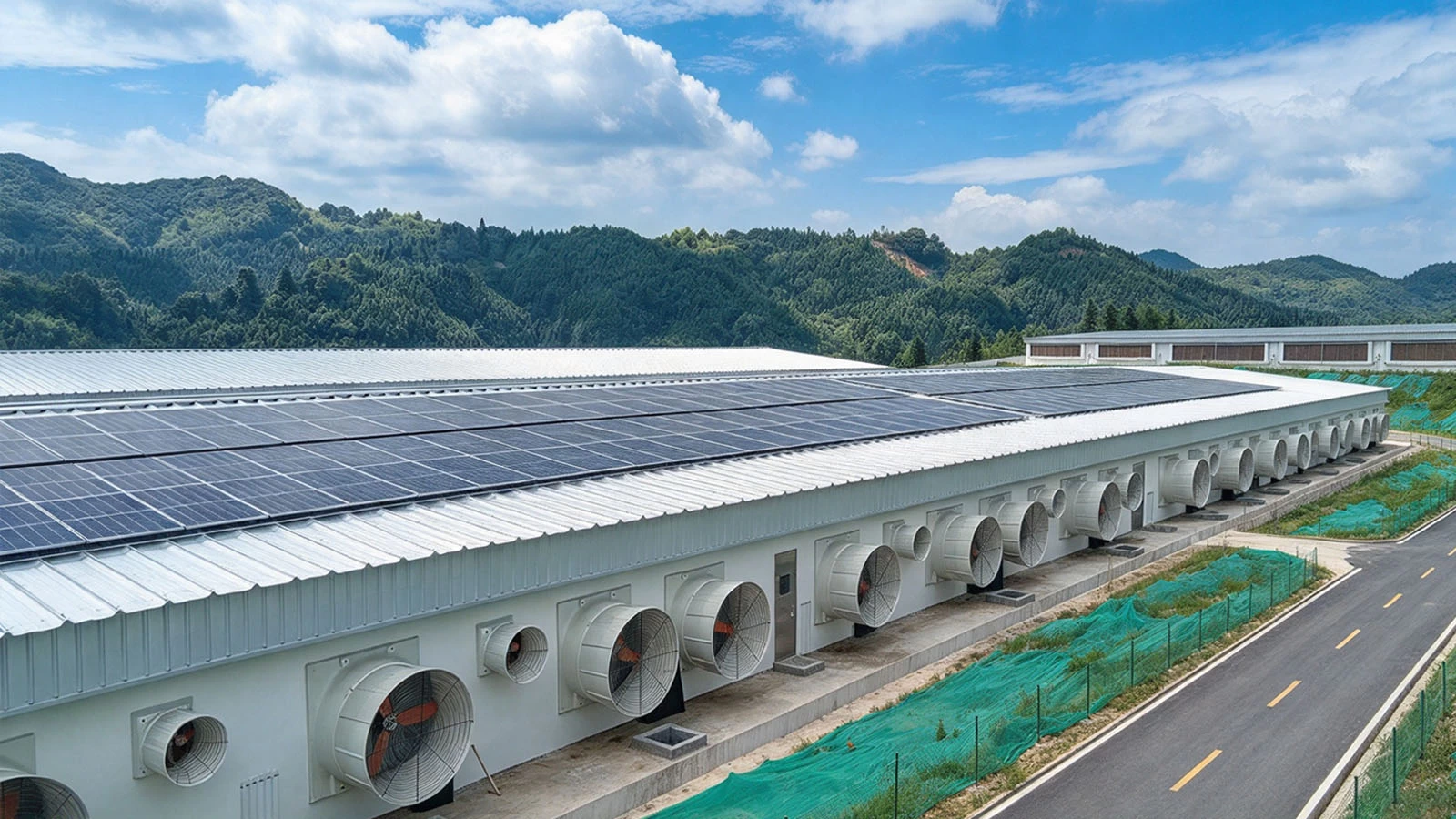
Getting ventilation right in a commercial poultry house isn't just about blowing air—it is a direct driver of your Feed Conversion Ratio (FCR), bird health, and ultimate flock performance. Under-ventilate your poultry barn, and toxic ammonia buildup alongside heat stress will quickly cause high mortality. Over-ventilate, and your electricity bills will surge out of control.
One of the most common questions farm owners and ventilation engineers ask when designing a barn is: Which fan models should I choose, and how many birds can a 900 mm, 1000 mm, or 1380 mm fan support?
In this guide, we break down the industry specifications for standard box and cone exhaust fans (900 mm / 36", 1000 mm / 40", and 1380 mm / 54"), provide a step-by-step sizing formula, and help you determine exact fan requirements for your flock.
 |
1. Understanding Standard Fan Sizes in the Global Market
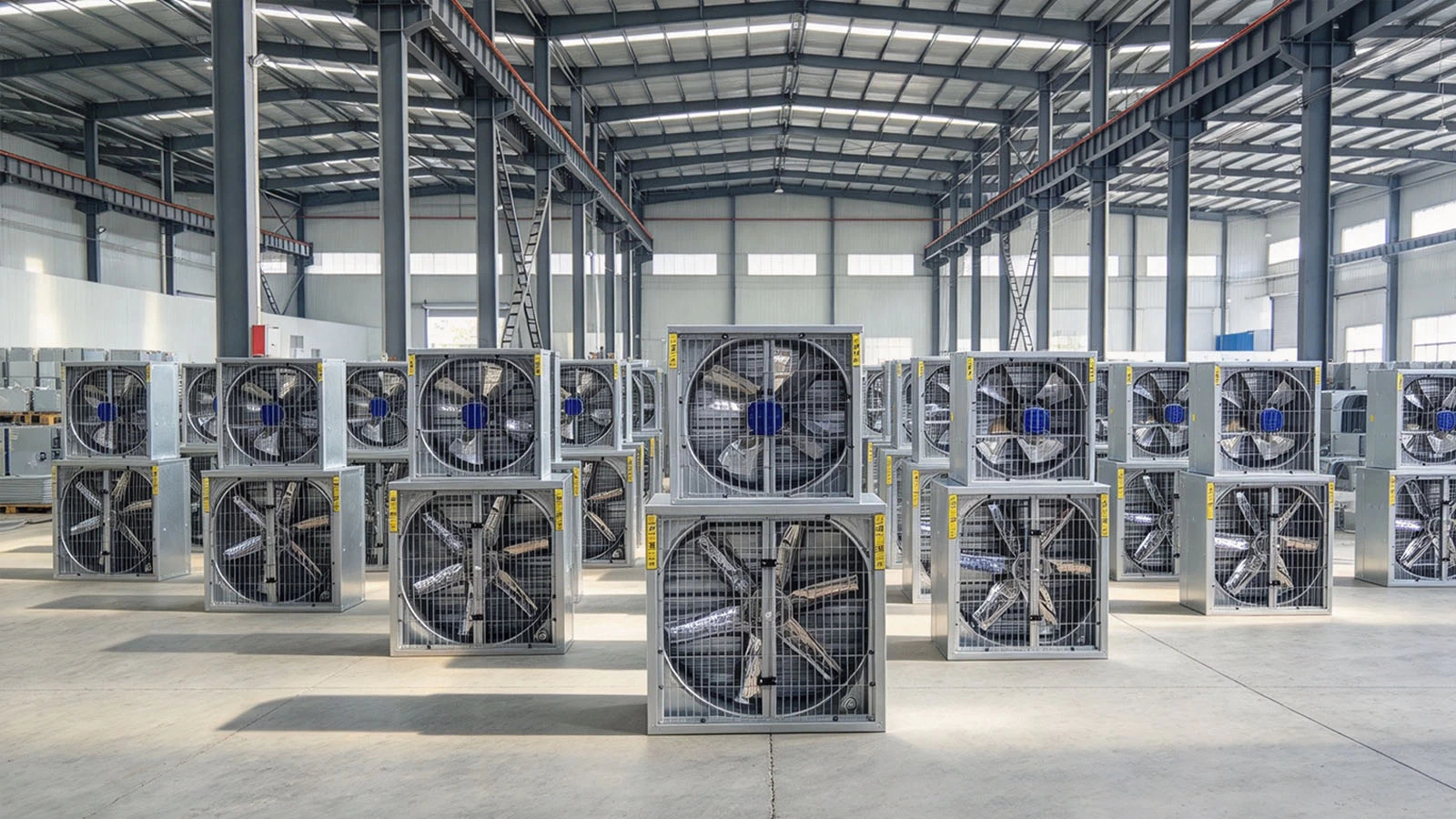
In international agricultural equipment standards, ventilation fans are categorized either by frame dimensions or blade diameter:
- 900 mm (36-inch): Primarily used for minimum ventilation, winter air exchange, side-wall air intake assistance, or smaller layer farms.
- 1000 mm (40-inch): The ideal transitional ventilation fan, offering a balance between controlled airflow and moderate energy consumption.
- 1380 mm (54-inch / 50-inch blade): The undisputed backbone of tunnel ventilation in modern commercial broiler and breeder houses worldwide.
2. Quick Reference Table: Fan Capacity & Estimated Bird Coverage
Note: Airflow values (CFM / m³/h) are based on standard operating conditions at 20–25 Pa static pressure. Bird count estimates assume mature broilers at a target market weight of 2.5 kg (5.5 lbs) under maximum hot-weather ventilation rates.
| Fan Model | Frame Size | Blade Diameter | Rated Airflow (CFM) | Rated Airflow (m³/h) | Estimated Bird Capacity (2.5 kg Broilers) | Typical Application |
900 mm (36") | 900x900x450 | 750mm( | 11,800 – 14,000 | 20000-24000 | 2,000 – 2,500 birds | Minimum ventilation, side-wall transition |
1000 mm (40") | 1000x1000x450 | 900mm(36") | 16,500 – 19,000 | 28000-32000 | 3,000 – 3,500 birds | Transitional ventilation, layer cages |
1380 mm (54") | 1380x1380x45 | 1270mm(50") | 25,000 – 28,000 | 4,500 – 5,500 birds | Summer tunnel ventilation, high-density barns |
3. How to Calculate Required Fans for Your Barn (Step-by-Step)
To calculate the exact number of fans needed for your specific facility, follow this proven 4-step engineering formula used by commercial poultry designers:
Step 1: Calculate Total Live Weight
Total Live Weight (kg) = Total Bird Count X Target Weight per Bird (kg)
Step 2: Determine Required Maximum Ventilation Rate
In tropical and warm climate regions (such as Southeast Asia, Latin America, the Middle East, and Africa), international poultry management standards recommend a maximum warm-weather airflow requirement of 5.0 to 6.0 CFM per kg (or 8.0 to 10.0 m3 /h per kg) of live weight for mature broilers.
Total Required CFM = Total Live Weight (kg) x 5.5 CFM/kg
Step 3: Account for House Static Pressure Loss
Always factor in a 10–15% safety margin to account for static pressure resistance caused by evaporative cooling pads, wire mesh, and louvers.
Design CFM = Total Required CFM x 1.15
Step 4: Calculate Number of Fans
4. Real-World Case Study: 20,000 Broiler House Design
Let's put this calculation into practice for a standard commercial broiler barn in a warm climate:
- Target Flock: 20,000 Broilers
- Target Harvest Weight:
$2.5\text{ kg / bird}$ - Total Live Weight:
$20,000 \times 2.5\text{ kg} = 50,000\text{ kg}$ - Max Required Airflow:
$50,000\text{ kg} \times 5.5\text{ CFM/kg} = 275,000\text{ CFM}$ - Design CFM with Safety Factor (
$1.15$ ):$275,000 \times 1.15 = 316,250\text{ CFM}$
Fan Options Comparison for 20,000 Birds:
- Option A (1380 mm / 54" Fans @ 26,000 CFM output):
$$\frac{316,250}{26,000} \approx 12.16 \longrightarrow \mathbf{12\text{ to } 13\text{ Tunnel Fans}}$$ - Option B (1000 mm / 40" Fans @ 17,500 CFM output):
$$\frac{316,250}{17,500} \approx 18.07 \longrightarrow \mathbf{18\text{ Fans}}$$ - Option C (Hybrid Strategy - Recommended):
$$\mathbf{10\times 1380\text{ mm Fans}}\text{ for peak summer tunnel ventilation} + \mathbf{4\times 900\text{ mm Fans}}\text{ for winter/minimum ventilation.}$$
5. Key Selection Criteria Beyond Size
When purchasing poultry fans for export or commercial installations, size is only half the equation. Consider these technical features before finalizing your order:
- Drive Type: Belt-Drive vs. Direct-Drive
- 1380 mm Fans: Almost always belt-driven to keep blade RPM lower, maximizing CFM output per Watt while reducing motor wear.
- 900 mm Fans: Frequently direct-drive for simpler maintenance and fewer moving parts in minimum ventilation duty.
- Housing Material Selection
- Galvanized Steel (
$275\text{ g/m}^2$ Zinc Coating): Best for standard closed houses looking for a balance between price and structural rigidity. - Fiberglass (FRP): Essential for high-humidity environments, coastal regions, or barns using corrosive cleaning agents.
- Shutter & Cone Type
- Heavy Cone Extensions: Adding a discharge cone to a 1380 mm fan increases total airflow efficiency by 10–15% without extra electricity cost.
- Centrifugal Push-Open System: Ensures louvers stay 100% open during operation, avoiding air restriction caused by dust or wind backdrafts.
Conclusion & Next Steps
Selecting the right fan size isn't just about matching numbers—it's about creating a flexible, multi-stage ventilation system that responds dynamically to changing flock age and weather conditions.
- Use 1380 mm cone fans to handle maximum heat loads during peak tunnel ventilation.
- Use 900 mm or 1000 mm fans for accurate minimum airflow control during early brooding stages.
Need Custom Ventilation System Sizing for Your Farm Project?
Our technical engineering team designs complete agricultural ventilation packages including exhaust fans, evaporative cooling pads, air inlets, and environmental controllers tailored to your local climate.
👉 [Contact Our Engineers Today for a Free Barn Ventilation Layout & Quote!]