

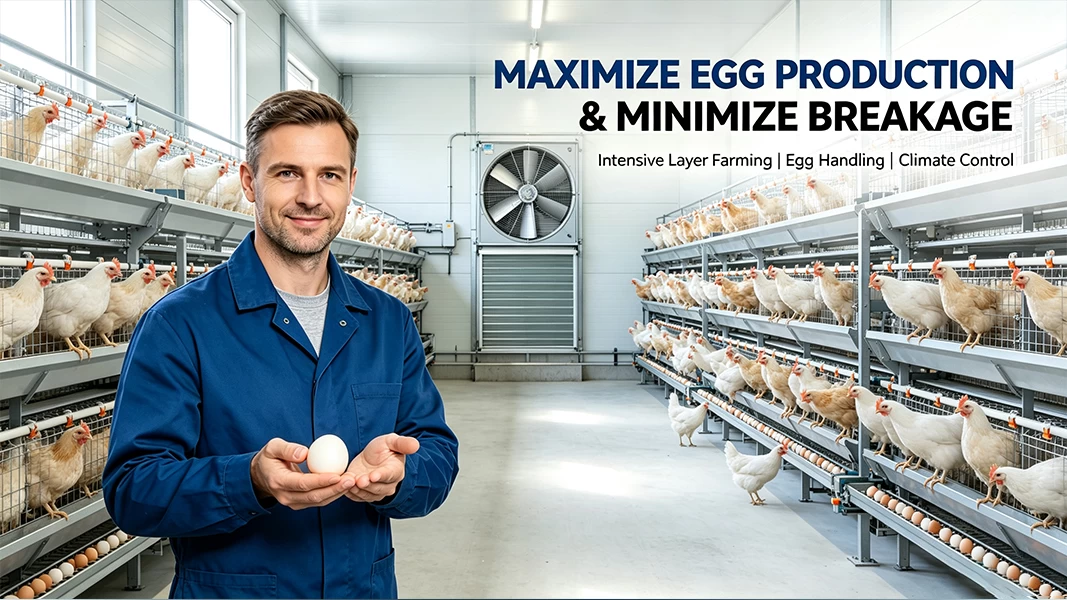
Maximize Egg Production & Minimize Breakage: A Complete Guide for Commercial Layer Farms
For commercial layer farm owners, two key metrics directly dictate daily profitability: egg production rate (lay rate) and egg breakage rate.
A minor 2% to 3% rate of egg breakage or a sudden drop in egg yield can silently erode tens of thousands of dollars in annual farm profits. While genetics and nutrition play important roles, the ultimate keys to sustaining high laying peak and preserving eggshell quality lie in environmental control and precise equipment management.
In this guide, we break down the root causes of low production and shell damage, along with practical engineering solutions to safeguard your yields.
 |
Part 1: Key Factors Impacting Egg Production and Shell Quality
1. Temperature Stress & Laying Peaks
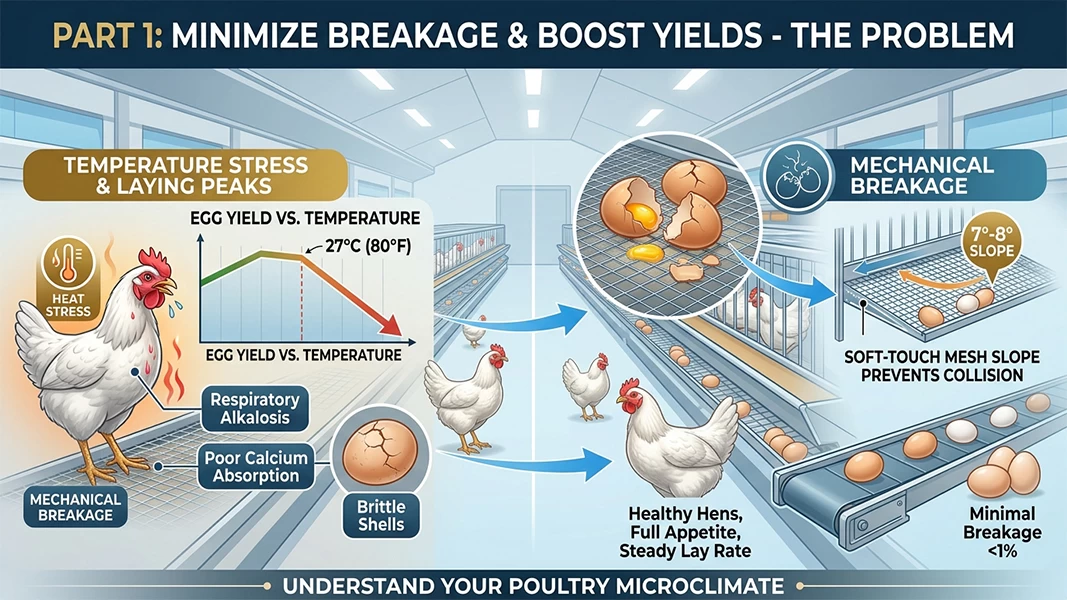
The Problem: Layers are extremely sensitive to temperature. When poultry house temperatures exceed 27°C (80°F), hens experience heat stress, leading to decreased feed intake and inadequate nutrient absorption.
The Impact: A drop in feed intake directly reduces laying rates and causes smaller egg sizes. At severe heat stress levels, egg production can drop by 10% to 30%.
2. Microclimate, Calcium Absorption & Shell Thinning
The Problem: High temperatures cause hens to pant rapidly to cool down, causing respiratory alkalosis. This alters blood pH and severely inhibits calcium carbonatization—the core material of eggshells.
The Impact: Thin, brittle shells that break easily during laying, collection, or transport.
3. Equipment Design & Mechanical Breakage
The Problem: Outdated cage design, overly steep bottom mesh slopes, harsh mechanical egg collection, or over-crowded cages cause eggs to collide with each other or the cage wire.
 |
Part 2: Integrated Equipment Solutions to Elevate Yields and Protect Eggs
To maintain a steady 90%+ laying peak while keeping egg breakage below 1%, modern poultry farms rely on an integrated equipment strategy:
1. Precision Ventilation & Cooling: Beat Heat Stress
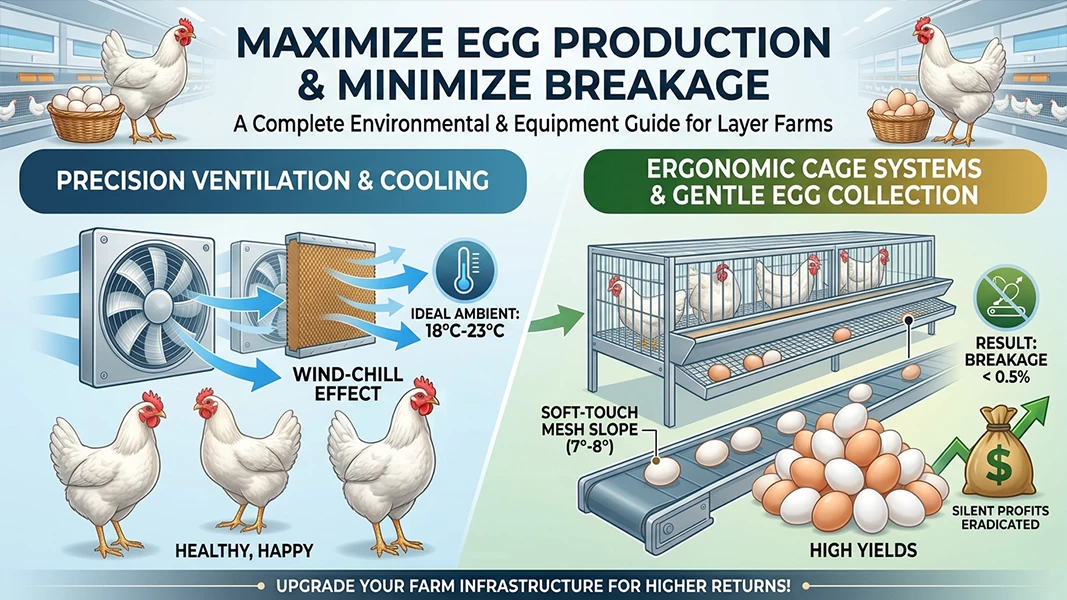
Maintaining an ideal ambient temperature (18°C–23°C) is essential for optimum feed conversion and shell strength.
Evaporative Cooling Pads + Negative Pressure Exhaust Fans: By combining high-efficiency fiberglass/galvanized exhaust fans with wet cooling pads, you create a longitudinal tunnel ventilation system. The resulting wind-chill effect lowers effective temperatures by 5–10°C, ensuring hens stay cool, maintain full appetite, and absorb calcium efficiently even during scorching summers.
2. Ergonomic Battery Layer Cages: Prevent Structural Damage
The physical design of the cage floor directly determines initial egg intactness.
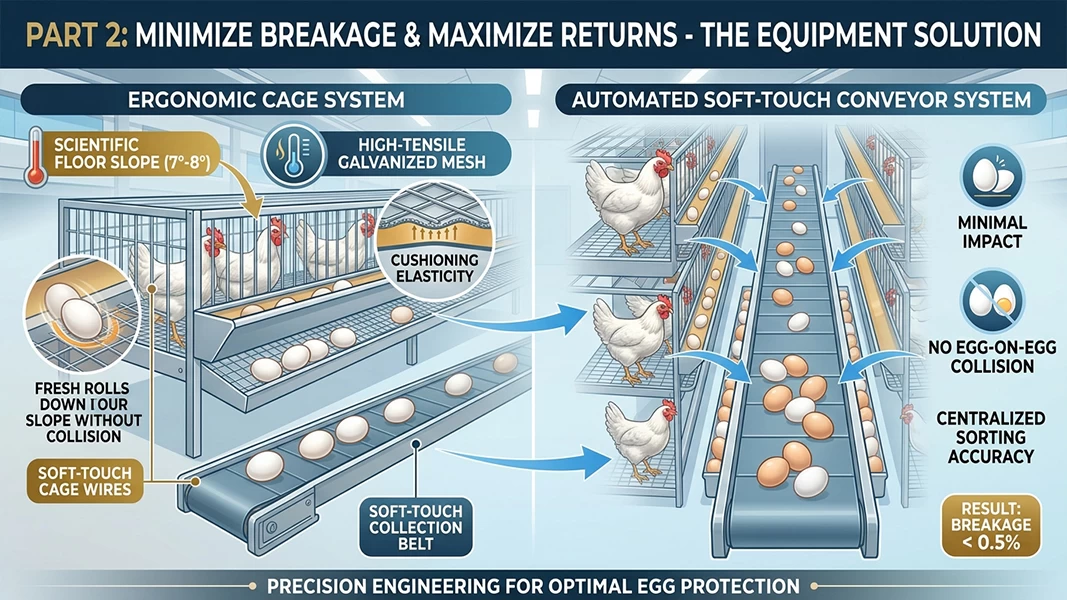
Optimized Bottom Mesh Slope: Modern H-Type or A-Type layer cages feature a scientifically calculated bottom mesh inclination (typically 7° to 8°). This allows freshly laid eggs to roll out smoothly without acquiring high momentum that causes impact cracks.
High-Tensile Galvanized Mesh: Smooth, corrosion-resistant mesh with optimal elasticity cushions the egg's impact upon landing.
3. Automated Egg Collection Systems: Gentle Handling at Scale
Manual egg collection is labor-intensive and accounts for a high percentage of crack rates due to human error.
Soft-Touch Collection Belts & Conveyors: Automatic egg collection systems gently receive eggs from the cage tray and convey them smoothly to the central sorting area, reducing collection breakage rates to under 0.5%.
 |
Part 3: Daily Operational Checklist for Low Breakage
Calibrate Fan & Cooling Pad Timers: Ensure ventilation automatically scales up before peak afternoon heat to avoid thermal spikes.
Inspect Egg Belts & Transition Points: Clear dust, feathers, and debris regularly to prevent egg jams along conveyor curves.
Optimize Nutrition & Lighting: Pair proper environmental control with balanced calcium-to-phosphorus ratios and consistent 16-hour lighting schedules.