

As summer temperatures soar, heat stress becomes one of the greatest threats to poultry production. Chickens lack sweat glands and are covered in feathers, making them exceptionally vulnerable to high ambient temperatures. When house temperatures rise above 30°C (86°F), feed intake drops significantly, egg production plummets, and severe heat stress can lead to spike mortality.
 |
Evaporative cooling pad systems (wet pad systems), paired with negative-pressure tunnel ventilation, are the most cost-effective and efficient solution for modern enclosed poultry houses. However, while some farms achieve a temperature drop of 6–10°C, others struggle with excessive humidity, poor cooling efficiency, or respiratory issues among their flock.
This guide breaks down how evaporative cooling pads work and how to optimize them for peak efficiency.
1. How Evaporative Cooling Works: The Science of Heat Absorption
The fundamental principle behind cooling pads is latent heat of vaporization:
- Exhaust fans at one end of a sealed poultry house create negative pressure.
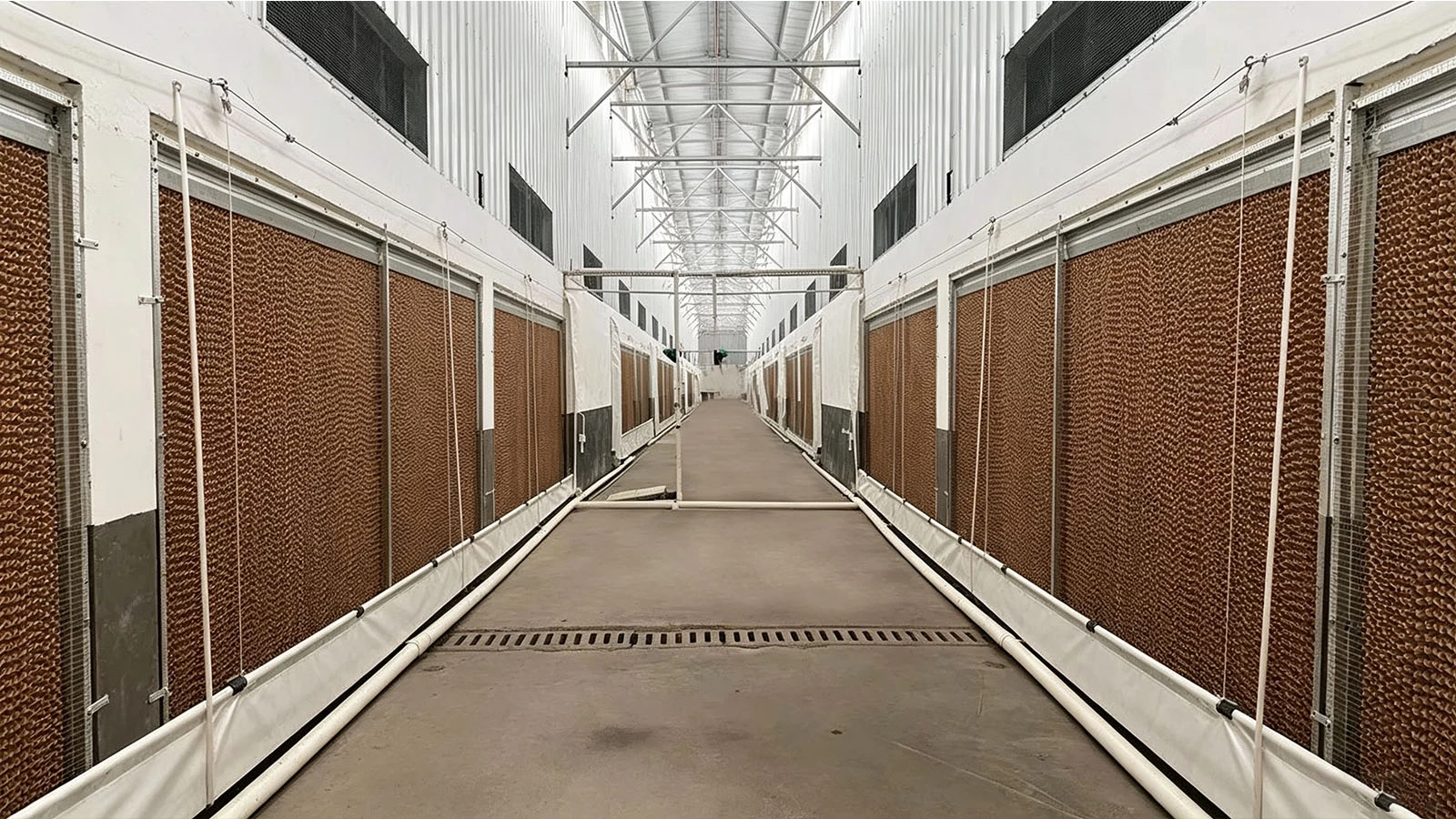
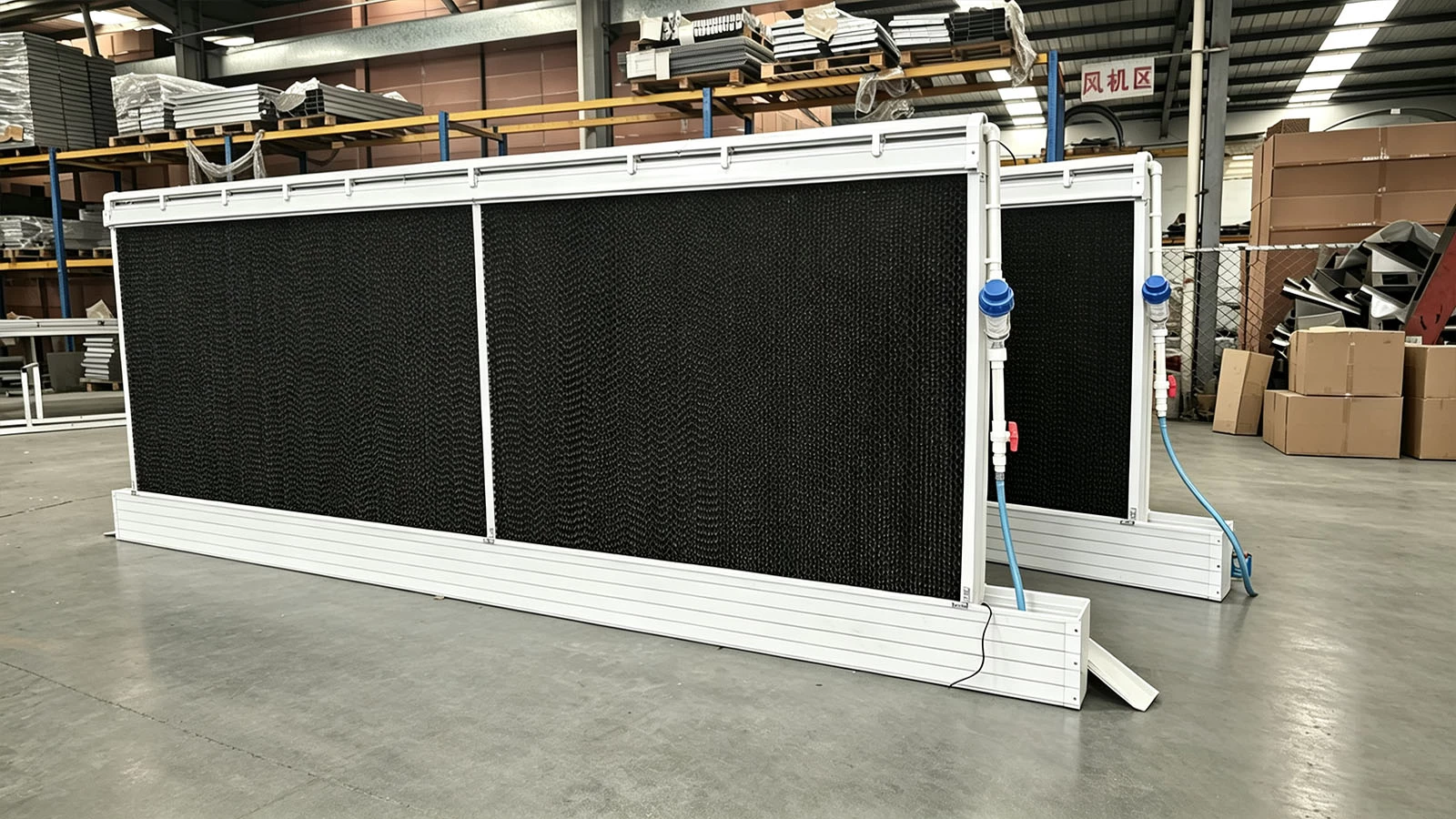
- Hot, dry outside air is drawn through wet cellulose pads at the opposite end.
- As the air passes through the water-soaked honeycomb structure, water evaporates into vapor, absorbing sensible heat from the air and significantly dropping the incoming air temperature.
Performance Benchmark: Under low relative humidity conditions (<50%), a properly sized pad system can reduce incoming air temperature by 6°C to 12°C (10°F to 20°F).
2. Standard Application Guidelines
To maximize cooling efficiency without creating adverse side effects, follow these baseline standards:
Airflow Velocity & Pad Area
If the pad area is too small, air velocity across the pad will be too high, spraying water droplets onto the litter and causing uneven cooling. If it is too large, you waste money and lose proper negative pressure control.
- Recommended Pad Air Velocity: For a standard 15 cm (6-inch) thick cooling pad, keep air velocity through the pad between 1.5 and 2.0 m/s (300–400 fpm).
Water Quality & Circulation
- Water Quality: Use clean, soft water. Hard water causes calcium scale buildup that clogs pad pores, while dirty water promotes algae and bacteria growth.
- Reservoir Sizing: Ensure your water tank or sump is adequately sized—typically 20–30 liters of water per square meter of pad surface.
3. Five Key Strategies to Optimize Cooling Pad Efficiency
Many growers make the mistake of running the water pump continuously without monitoring humidity or air speed. To achieve optimal performance, implement these five optimization strategies:
Strategy 1: Leverage the "Wind Chill Effect"
Air temperature drop alone is not enough; a bird's perceived temperature (chill factor) depends heavily on air speed over its body.
- Optimization: Maintain a tunnel air velocity over the birds of 2.0 to 2.5 m/s (400–500 fpm) when pads are running. Every 0.5 m/s increase in air velocity provides an additional 1°C to 2°C reduction in perceived temperature.
Strategy 2: Control Relative Humidity
When ambient relative humidity exceeds 70%, the air's capacity to absorb evaporated water drops sharply. Running water continuously under humid conditions simply turns the poultry house into a muggy sauna.
- Optimization:
- Intermittent Pumping: Use a timer to run pumps intermittently (e.g., ON for 2–3 minutes, OFF for 5–7 minutes) to keep pads damp rather than soaked.
- Humidity Cut-off: Program your controller to shut off the water pump when indoor humidity reaches 75%, relying solely on maximum fan speed for wind-chill cooling.
Strategy 3: Prevent "Cold Shock" at the Front and "Heat Stagnation" at the Rear
Chickens near the pad inlet are prone to cold drafts (cold shock), whereas birds near the fans experience warmer, humid air that has absorbed heat and moisture along the length of the house.
- Optimization:
- Deflectors & Baffles: Install air deflectors near the pad inlets to direct incoming cool air upward, allowing it to mix with warm room air before hitting bird level.
- Staged Fan Management: Stage exhaust fans progressively to keep the temperature differential between the front and back of the house under 2°C to 3°C.
Strategy 4: Maintenance, Algae Control, and Drying Cycles
- Pre-filters: Place washable mesh screens outside the cooling pads to catch dust, pollen, and feathers.
- Algae Treatment: Add approved quaternary ammonium compounds to the sump tank weekly to prevent algae growth.
- Daily Drying Cycle: Turn off the water pumps 30–45 minutes before dark (or before final lighting adjustment) while keeping the fans running. Thoroughly drying the pads daily kills algae spores and mold, extending pad lifespan by 2 to 3 years.
Strategy 5: Ensure House Airtightness
If there are structural leaks or unsealed doors, negative pressure will draw warm, uncooled air into the house through those cracks, bypassing the cooling pads entirely.
- Optimization: Perform smoke or static pressure tests before summer. Seal all cracks, end-door gaps, and unused side-wall vents with expanding foam or weatherstripping.
 |
Summary
Evaporative cooling pads are far more than a "turn-it-on-and-forget-it" system. Achieving optimal performance requires balancing air speed, humidity, temperature, and bird biology:
- Hot & Dry Weather: Maximize pad evaporation combined with high wind speed.
- Hot & Humid Weather: Restrict water application; rely primarily on maximum air velocity (wind chill).
- Routine Maintenance: Ensure clean water, enforce daily pad drying, and maintain strict house tightness.
By refining these controls, you can protect your flock from heat stress, lower energy costs, and maintain consistent growth rates and egg production throughout the hottest months.