

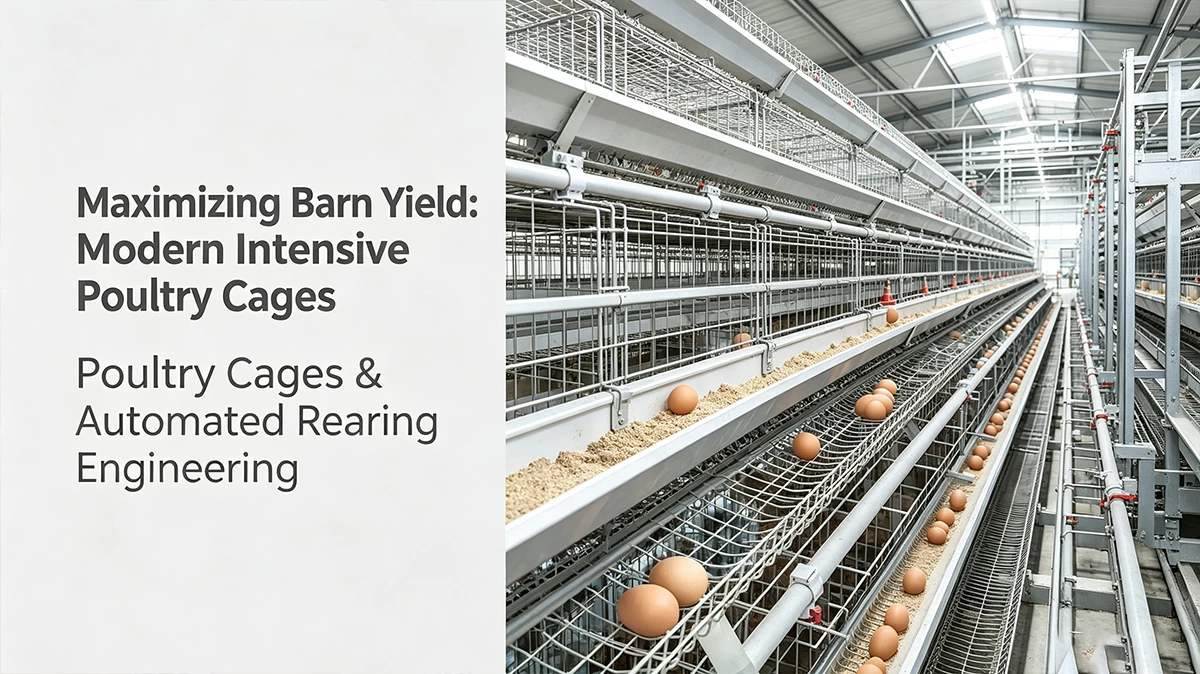
Maximizing Barn Yield: Modern Intensive Poultry Cages & Automated Rearing Engineering
As global meat and egg consumption rises, the poultry industry is shifting rapidly toward full automation and high-density farming. Traditional, labor-intensive open-house rearing is no longer economically viable. To remain competitive, commercial poultry producers must scale up, secure bio-security, and lower operational overhead.
The ultimate answer to these modern farming challenges lies in Intensive Automated Rearing Systems.
When properly engineered, transitioning to high-density battery cage configurations equipped with automatic feeding, drinking, and manure removal systems can dramatically skyrocket your flock's production efficiency while offering a massive Return on Investment (ROI).
Today, the technical engineering team at North Husbandry decodes the structural and management advantages of modern automated poultry rearing systems.
1. The Architectural Choice: H-Type vs. A-Type Commercial Battery Cages
The foundation of any high-density intensive rearing system is the cage design. While both types serve modern farms, they fit different scales of operations:
A-Type Framework:
Best suited for small to medium-sized poultry barns with natural or simple positive-pressure ventilation. They offer excellent natural lighting and ventilation airflow but have a lower space utilization ceiling compared to H-type configurations.
H-Type Framework (The Gold Standard for Enterprise Farms):
Designed specifically for large-scale, fully enclosed, climate-controlled environments. Cages are stacked directly on top of one another horizontally. This structure allows you to build upward (often 3 to 8 tiers high), quadrupling the housing capacity of a single barn footprint compared to floor-rearing systems.
2. Precision Broiler Pan Feeding Lines: Eliminating Feed Waste
Feed accounts for nearly 60% to 70% of total poultry production costs. In traditional floor environments or poorly configured cages, birds regularly scratch, spill, and waste massive percentages of feed.
Modern automated rearing engineering tackles this with closed pan-feeding systems:
High-Precision Augers: Feed is automatically conveyed via flexible steel augers from the outdoor bulk silo directly into every individual cage line pan.
Anti-Wastage Pan Engineering: Deep-dish, specially contoured grill pans allow growing broilers or layers to eat comfortably without allowing them to scratch feed out onto the cage floor.
Sensor-Controlled Delivery: The end pan features an electronic proximity sensor. When the birds finish the feed, the system automatically triggers the auger motor, guaranteeing fresh feed is delivered 24/7 without manual intervention.
3. Hygienic Poultry Nipple Drinking Systems: Clean Water, Dry Manure
Water quality directly impacts poultry health, feed conversion ratios (FCR), and overall gut stability. Standing open water troughs are hotbeds for bacterial growth and cross-contamination.
Modern systems utilize advanced Nipple Drinking Lines:
360-Degree Nipple Activation: High-grade stainless steel nipples allow young chicks and adult layers alike to drink easily from any angle.
Leak-Proof Valves & Drip Cups: Precision engineering ensures that the valve pops open only when triggered by a bird's beak and seals perfectly instantly. Drip cups catch any minor overspray, preventing water from dripping onto the manure belts below.
Integrated Pressure Regulators: Ensures equalized water pressure from the front to the very back of a 150-meter long barn, keeping water delivery completely uniform.
4. Automatic Manure Belts: The Secret to Micro-Climate Control
One of the biggest issues with intensive poultry rearing is the rapid accumulation of manure, which releases toxic ammonia ($NH_3$) and carbon dioxide ($CO_2$) gases, compromising bird respiratory tracts.
In a premium H-type automated cage system, longitudinal PP (polypropylene) manure removal belts run underneath every single tier of cages. Every few days, the automated motor drives the belts to smoothly transport all droppings out of the house into an external truck.
By removing waste promptly, you dramatically lower the ammonia levels in the air. This reduces the pressure on your environmental control fans, improves bird health, and drops mortality rates.
Why Intensive Automation Outperforms Traditional Floor Rearing
| Metric / Feature | Traditional Floor Rearing | Automated H-Type Cage System |
| Stocking Density | Low ($10\text{-}15 \text{ birds/m}^2$) | High ($40\text{-}60+ \text{ birds/m}^2$) |
| Feed Conversion Ratio (FCR) | Worse (More bird movement & waste) | Better (Calmer birds, specialized feeding) |
| Labor Requirement | High (Manual feeding/cleaning) | Ultra-Low (One operator per barn) |
| Disease Control | Difficult (Birds contact litter/waste) | Excellent (Waste isolated instantly) |
Engineered for Performance: Build Your Layout with North Husbandry
Moving toward full automation is a significant step, and every barn layout demands unique calculations. Factors like your target bird numbers, local ambient temperatures, and structural dimensions change the engineering dynamics of your feeding, drinking, and cage tiers.
At North Husbandry, we don't just supply long-lasting, hot-dip galvanized cages, high-precision feed augers, and hygienic water lines—we design integrated systems that work seamlessly under extreme conditions.
📩 Ready to multiply your barn's capacity and slash labor costs? Contact North Husbandry today! Submit your barn size or target bird volume, and our agricultural engineering experts will design a customized Intensive Automated Rearing Layout Blueprint and Quote absolutely free.